martes, 10 de enero de 2017

LESSON 7- TO HAVE VS HAVE TO

HELLO MY KIDS, GOD BLESS YOU MORE!!

El verbo "to have" significa haber o tener

I have a car- Yo tengo un coche

To have es uno de los verbos auxiliares en inglés junto con to doto be y will.

Presente Simple

Estructura
Sujeto + have/has
ConjugaciónSignificado
I haveyo tengo
you havetú tienes
he has 
she has 
it has
él tiene
ella tiene
ello tiene
we havenosotros tenemos
you havevosotros tenéis
they haveellos tienen


 Verbo "tener - haber" (Pasado)


Como verbo TENER

Como verbo HABER
ENGLISH
ESPAÑOL
I had
Yo tuve/tenía
You had
Tú tuviste/tenías
He had
El tuvo/tenía
She had
Ella tuvo/tenía
It had
El/Ella tuvo/tenía
We had
Nosotros/as tuvimos/teníamos
You had
Vosotros tuvisteis/teníais (*)
Ustedes tuvieron/tenían (**)
They had
Ellos/as tuvieron/tenían
ENGLISH
ESPAÑOL
I had
Yo había
You had
Tú habías
He had
El había
She had
Ella había
It had
El/Ella había
We had
Nosotros/as habíamos
You had
Vosotros habíais (*)
Ustedes habían (**)
They had
Ellos/as habían
 más utilizado en España; El más utilizado en América Latina.


INTERROGATIVE    

Como verbo TENER


Como verbo HABER
ENGLISH
ESPAÑOL
Had I?
¿Tuve/Tenía yo?
Had you?
¿Tuviste/Tenías tú?
Had he?
¿Tuvo/Tenía él?
Had she?
¿Tuvo/Tenía ella?
Had it?
¿Tuvo/Tenía él/ella?
Had we?
¿Tuvimos nosotros/as?
Had you?
¿Tuvisteis vosotros? (*)¿Teníais vosotros? (*)
¿Tuvieron ustedes? (**)
Had they?
¿Tuvieron ellos/ellas?
¿Tenían ellos/ellas?
ENGLISH
ESPAÑOL
Had I?
¿Había yo?
Had you?
¿Habías tú?
Had he?
¿Había él?
Had she?
¿Había ella?
Had it?
¿Había él/ella?
Had we?
¿Habíamos nosotros/as?
Had you?
¿Habíais vosotros? (*)¿Habían ustedes? (**)
 
Had they?
¿Habían ellos/ellas?


Contracciones 

Sin contraerContraído
I haveI've
you haveyou've
he has
she has
it has
he's
she's
it's
we havewe've
you haveyou've
they havethey've


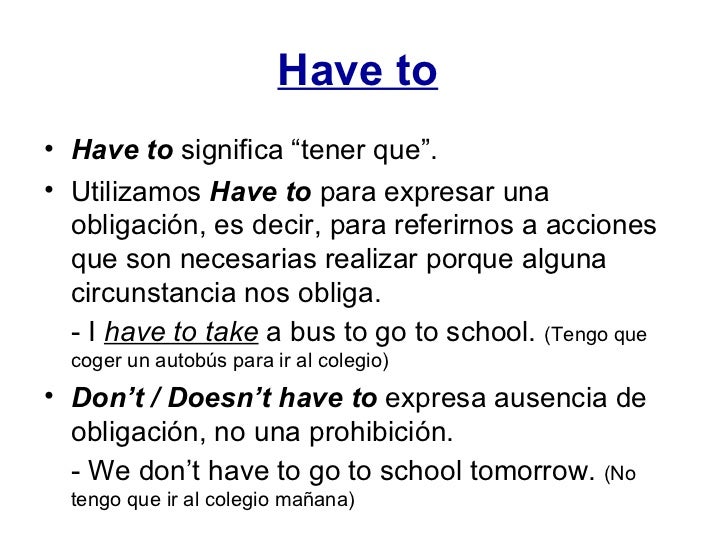
Have to - obligación en inglés

es un verbo semi-modal que se usa muy frecuentemente en inglés para expresar obligación. Decimos semi-modal porque no sigue las reglas de los verbos modales
¿CÓMO SE FORMA? 

Afirmativas 
have to wear, You have to wear, He/she/it has to wear, We have to wear, They have to wear

I have to wear uniform at work (tengo que llevar uniforme en el trabajo) 
The doctor says she has to stop smoking (el médico dice que ella tiene que dejar de fumar) 

Negativas 
don't have to wear, you don't have to wear, he/she/it doesn't have to wear, we don't have towear, they don't have to wear

I don't have to pay this bill until November (no tengo que pagar esta factura hasta noviembre)
She doesn't have to work on Saturdays (ella no tiene que trabajar los domingos)

Interrogativas*
Do I have to wear...? Do you have to wear...? Does he/she/it have to wear...? Do we have towear...? Do they have to wear...? 

Do they have to work everyday? (¿tienen ellos que trabajar todos los días?) 
Does she have to take an exam? (¿tiene que examinarse?) 


LESSO 6 - CAN AND COULD


LESSON 5- COMPARATIVE AND SUPERLATIVE


lunes, 9 de enero de 2017

LESSON 4 - ADJECTIVES AND ADVERBS


LESSON 3 - DAILYN ROUTINES


LESSON 2- PRESENT SIMPLE

Presente simple son las acciones que realizamos cotidianamente y para eso usamos el modal auxiliar do/does.


  • Do [du] (para I, You, They, We) 
  • Does [das] (para He, She, It)


  • Como Verbo.En este caso, do/does significan "hacer" generalmente algo abstracto ("make" es más para "hacer/ fabricar" algo con las manos. Aprender a utilizar "do y make"). 


    Ejemplo:
    I do My Homework. // Hago mi tarea en casa. Lo usamos como verbo.Do you Clean the Room? // Limpias el Cuarto?. Lo usamos como auxiliar.

    Como Auxiliar.
    Lo usamos para preguntar y negar en el tiempo presente.Para el Pasado utilizamos "did" para todas las personas. En estos casos no lo podemos traducir en español ya que es una construcción propia del inglés.Recuerda: Cuando utilizas do/does como verbo auxiliar para preguntar o negar, el verbo principal siempre va en infinitivo, sin "s"


    El infinitivo inglés va normalmente precedido de la partícula 'to':
    To be / ser
    To run / correr
    To speak / hablar
    El infinitivo expresa el significado del verbo de una manera general, sin referencia a tiempo alguno.


    Tercera persona : en el presente simple existe la tercera persona de singular la cual posee una regla gramatical muy sencilla y la aplicaremos con he, she, it.Regla 1 : se agrega "ies" cuando el verbo termina en "y" procedida de una consonante.ejemplo:fly- flies      try-trieshe tries to go to the home.Regla 2 : se agrega "s" cuando el verbo termina en "y" procedido de una vocal.ejemplo:play-playsshe plays tennis.Regla 3: se le agrega "es" cuando el verbo tienes las terminaciones s,c,z,sh,ch,x,o.ejemplo:go-goes  finish-finishes  mix-mixes catch-catches fix-fixes.Regla 4: se le agrega "s" en todas las otras terminaciones no antes mencinadas.ejemplo:
    answer-answers   need- needs  open-opens 


    Formula: sujeto + verbo en presente + complementoEstructura:
    AffirmativeQuestionNegative
    I do
    you do
    he does
    she does
    it does
    we do
    you do
    they do
    do I ?
    do you ?
    does he ?
    does she ?
    does it ?
    do we ?
    do you ?
    do they ?
    I do not
    you do not
    he does not
    she does not
    it does not
    we do not
    you do not
    they do not
    Negative
    question 
    Negative contractionNegative Question
    with contraction
    do I not ?
    do you not ?
    does he not ?
    does she not ?
    does it not ?
    do we not ?
    do you not ?
    do they not ?
    I don't
    you don't
    he doesn't
    she doesn't
    it doesn't
    we don't
    you don't
    they don't
    don't I ?
    don't you ?
    don'tes he ?
    don'tes she ?
    don'tes it ?
    don't we ?
    don't you ?
    don't they ?

    Repuestas cortas yes i dono i do notno i don'tejemplo de do/does conjugandodo my homeworkdo i do my homework?do make my homework // forma enfatica se traduce como: si hago la tarea.do not do my homeworkdo i not do my homework? don't do my homeworkdon't i do my homework?Repuestas cortas.yes i dono i do notno i don't


    La funcion del "does"  es extraer las terceras personas del singular de los verbos, aquí te muestro un ejemplo:


    she goes
    does she go
    she does go?// afirmativa enfáticashe does not go
    does she not go?
    she doesn't go
    doesn't she go?


    En este ejemplo paso lo siguiente pon mucha atención por favor.


    Cuando le agregas el "es" al "do" se convierte en does osea do+es es igual a does, entonces cuando utilizas el does ya no es necesario poner el verbo en tercera persona, porque el  "es" que le agregamos al "do" absorbe la tercera persona del singular de los verbos.
    does she go// ya no es necesario decir: does she goesporque el "does" le absorve el "es" entiendes y por eso lo hacemos así.
    does she go.


    x